
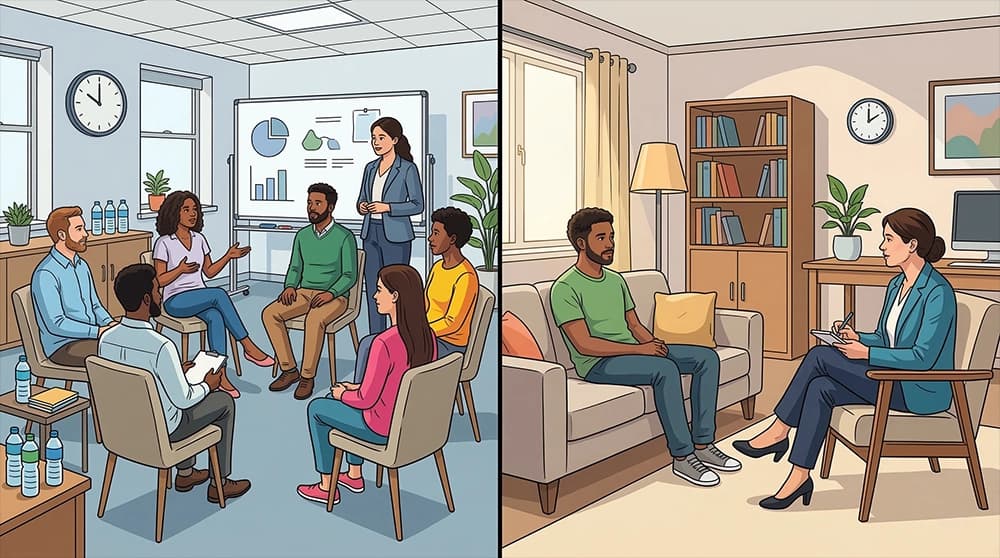
IOP provides structured, multi-day weekly programming for people who need more support than standard outpatient therapy but do not require residential care. Choosing between them depends on clinical needs, schedule, and recovery stage.
- 1IOP typically involves 9 to 15 hours of programming per week, while standard outpatient therapy usually involves one to two sessions weekly.
- 2Both levels of care allow people to live at home and maintain daily responsibilities during treatment.
- 3IOP includes group therapy, individual counseling, and skill-building components in a coordinated weekly schedule.
- 4Standard outpatient therapy is often appropriate as a step-down from IOP or for people with milder clinical presentations.
- 5The right level of care depends on clinical assessment, not personal preference alone, and can be adjusted as recovery progresses.
For people exploring treatment options in San Diego, one of the most common questions is whether IOP vs outpatient therapy is the better fit. Both allow you to live at home while receiving care, but they differ significantly in structure, time commitment, and clinical intensity. Understanding those differences is essential for choosing a level of care that actually matches where you are in recovery.
This comparison breaks down what each option involves, who each is designed for, and how to determine which one aligns with your needs.
What is intensive outpatient programming?
An intensive outpatient program provides structured treatment across multiple days each week without requiring participants to live on-site. IOP at Amity San Diego typically includes:
- 9 to 15 hours of programming per week, spread across three to five days
- Group therapy sessions focused on relapse prevention, coping skills, and peer support
- Individual counseling to address personal treatment goals
- Psychoeducation on topics like stress management, emotional regulation, and substance use patterns
- Care coordination with outside providers, including psychiatrists and primary care physicians
IOP is built for people who need more support than a single weekly session can provide but who do not require the around-the-clock supervision of residential treatment. It offers a level of accountability and clinical contact that standard outpatient therapy does not.
What does standard outpatient therapy look like?
Standard outpatient therapy is the least intensive level of formal treatment. It typically involves:
- One to two sessions per week, each lasting 45 to 60 minutes
- Individual therapy, group therapy, or a combination of both
- Flexible scheduling that integrates easily into work, school, and family routines
- Ongoing support for people who have completed higher levels of care or who present with lower clinical severity
Outpatient therapy works well as a long-term maintenance option or as the first level of care for people whose substance use or mental health concerns are less acute. It is also a common step-down after completing IOP.
How do IOP and outpatient therapy compare side by side?
The clearest way to understand the difference between intensive outpatient vs regular outpatient care is to compare the core components directly.
| Feature | IOP | Standard Outpatient |
|---|---|---|
| Weekly hours | 9 to 15 hours | 1 to 2 hours |
| Sessions per week | 3 to 5 days | 1 to 2 days |
| Group therapy | Core component | May or may not be included |
| Individual counseling | Included weekly | Primary format |
| Structure level | High | Low to moderate |
| Typical duration | 8 to 12 weeks | Ongoing or as needed |
| Best suited for | Moderate severity, step-down from PHP/residential | Mild severity, maintenance, long-term support |
Both levels of care allow participants to continue living at home. The key distinction is how much clinical time and structure each provides within a given week.
Who is IOP designed for?
IOP is typically recommended for people in one of several situations:
- Stepping down from a higher level of care. After completing PHP or residential treatment, IOP provides continued structure while allowing more independence.
- Moderate clinical severity. People whose substance use or mental health symptoms are too significant for once-weekly therapy but who do not need daily full-day programming.
- Returning to daily life with support. IOP allows people to practice recovery skills in real-world settings while still receiving consistent clinical oversight.
- Previous treatment that was insufficient. If standard outpatient therapy did not produce adequate progress, stepping up to IOP can provide the additional support needed.
A clinical assessment determines whether IOP is the right fit. Factors like substance use severity, mental health diagnoses, home environment stability, and prior treatment history all inform that recommendation.
Who benefits most from standard outpatient therapy?
Standard outpatient therapy is appropriate when the clinical picture calls for less intensive intervention:
- People with stable recovery foundations who need ongoing therapeutic support without the structure of IOP
- Those completing IOP who are ready to step down but want to continue treatment at a reduced frequency
- Individuals with milder presentations whose substance use or mental health concerns can be effectively addressed with weekly sessions
- People managing co-occurring conditions who benefit from consistent check-ins but do not require intensive weekly programming
Outpatient therapy provides continuity. It keeps the therapeutic relationship active and gives people a consistent space to address challenges as they arise in daily life.
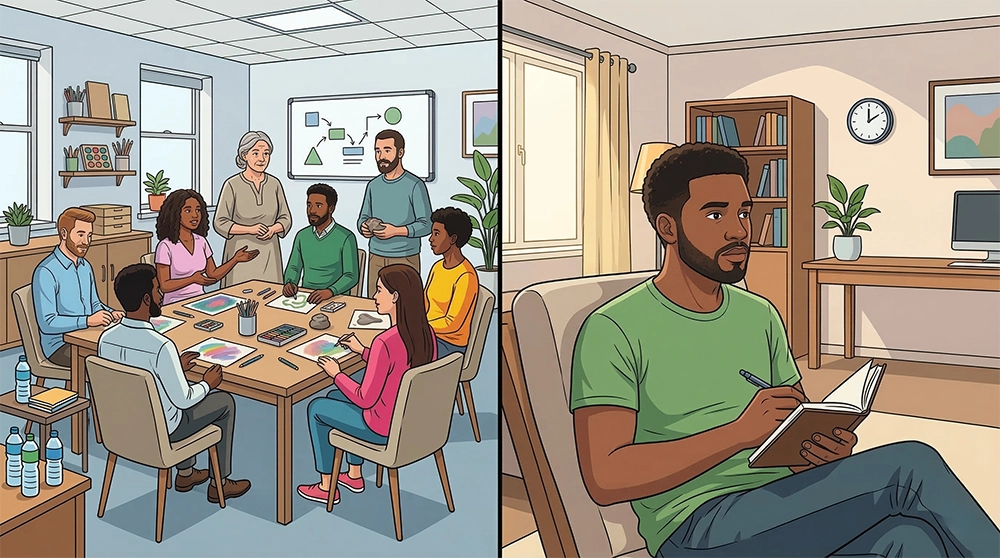
Can you move between levels of care?
Yes, and this flexibility is one of the strengths of outpatient-based treatment. The continuum of care model means that people can step up or step down based on how their recovery progresses.
Common transitions include:
- PHP to IOP: After completing structured daily programming, stepping down to IOP maintains clinical support while restoring more personal autonomy
- IOP to outpatient: Once IOP goals are met and stability is established, reducing to weekly outpatient sessions provides ongoing maintenance
- Outpatient back to IOP: If a person experiences increased stress, relapse warning signs, or a change in circumstances, stepping back up to IOP provides additional support without requiring residential placement
These transitions are guided by clinical assessment rather than a fixed schedule. Treatment plans at Amity San Diego are reviewed regularly to ensure the level of care continues to match the person's needs.
What factors should guide your decision?
Choosing between IOP and outpatient therapy is not about preference alone. Several clinical and practical factors inform the decision:
- Symptom severity: More acute presentations typically call for the higher structure of IOP
- Treatment history: Prior difficulty with less intensive care may indicate a need for IOP-level support
- Home environment: A stable, supportive living situation makes outpatient-level care more viable
- Daily obligations: Both options accommodate work and school, but IOP requires a larger weekly time commitment
- Recovery stage: Early recovery or recent discharge from a higher level of care often benefits from IOP before transitioning to outpatient
The admissions team can help clarify which level of care fits your situation based on a thorough assessment of these factors.
How does insurance coverage work for IOP and outpatient therapy?
Most major insurance plans cover both IOP and outpatient therapy as behavioral health benefits. Coverage specifics, including copays, session limits, and authorization requirements, vary by plan and provider.
Verifying coverage before starting treatment helps avoid unexpected costs and ensures continuity of care. Amity San Diego's team can assist with benefits verification and prior authorization to streamline the process.
Take the next step toward the right level of care
Whether IOP or outpatient therapy is the right fit depends on where you are today and what your recovery needs. Both are effective, evidence-supported options, and moving between them as your situation changes is expected and encouraged.
Call Amity San Diego at (888) 666-4405 to discuss your options with the admissions team, or verify your insurance to understand your coverage before getting started.
This content is for informational purposes only and does not constitute medical advice. Please consult a qualified healthcare professional for personalized guidance.
Frequently Asked Questions
What is the main difference between IOP and outpatient therapy?
The primary difference is intensity and time commitment. IOP typically requires 9 to 15 hours of structured programming per week across three to five days, while standard outpatient therapy usually involves one to two individual or group sessions per week. IOP provides more clinical contact and accountability for people who need a higher level of support.
Can I work or go to school while attending IOP?
Yes. IOP is designed for people who need intensive treatment but do not require 24-hour supervision. Most programs offer morning or evening scheduling options so participants can continue working, attending school, or managing family responsibilities during treatment.
How do I know if I need IOP or standard outpatient therapy?
A clinical assessment helps determine the appropriate level. IOP is generally recommended for people stepping down from residential or PHP care, those with moderate symptom severity, or individuals who have not responded well to less intensive outpatient treatment. Standard outpatient may be sufficient for people with stable recovery foundations who need ongoing support.
Is PHP a higher level of care than IOP?
Yes. A partial hospitalization program provides more hours of daily programming than IOP and is typically recommended for people who need near-daily structured treatment but do not require overnight residential care. PHP often serves as a step between residential treatment and IOP.
How do I get started with IOP or outpatient therapy at Amity San Diego?
Call Amity San Diego at (888) 666-4405 to speak with the admissions team. They can help determine which level of care matches your situation, walk you through scheduling options, and assist with insurance verification.
Sources & References
This article is based on peer-reviewed research and authoritative medical sources.
- Treatments for Substance Use Disorders — SAMHSA (2024)
- Types of Treatment Programs — NIDA (2024)
- Substance Use Treatment — MedlinePlus (2025)
Amity San Diego
Amity San Diego Medical Team