

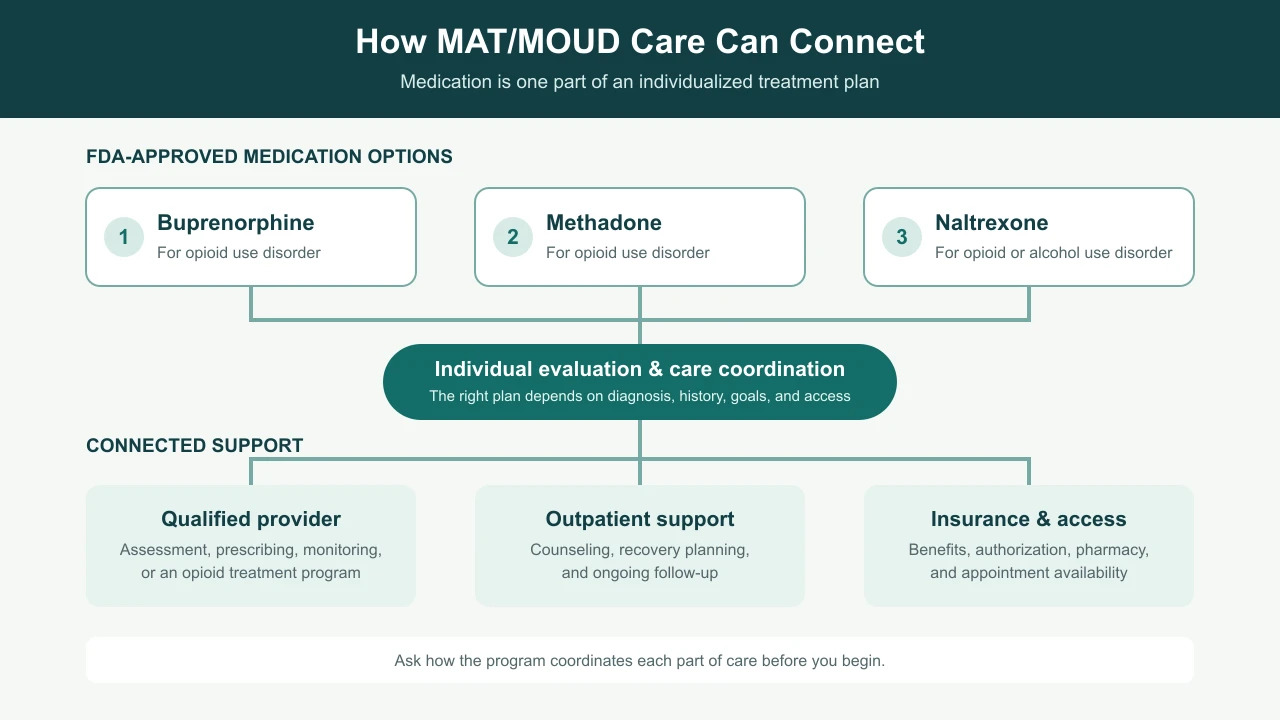
Medication-assisted treatment is a broad term often used for combining approved medication with behavioral health support. For opioid use disorder, FDA-approved medications include buprenorphine, methadone, and naltrexone. Ask which services a program provides directly, which require an outside prescriber or opioid treatment program, and how care is coordinated.
- 1Medication decisions require an individual evaluation by a qualified prescriber.
- 2Buprenorphine, methadone, and naltrexone are FDA-approved for opioid use disorder.
- 3A treatment program may provide medication, coordinate with an outside prescriber, or refer to another provider.
- 4Confirm current services, pharmacy or clinic requirements, follow-up, and insurance before starting.
People searching for medication-assisted treatment in San Diego may find several terms—MAT, MOUD, buprenorphine treatment, methadone programs, or naltrexone—without a clear explanation of how medication connects with counseling and outpatient care.
The first useful step is to separate general education from an individual medication decision. A qualified prescriber should evaluate the person's health, substance use, current medications, withdrawal risk, treatment goals, and previous response before recommending a medication.
Understand the Terminology
Medication-assisted treatment, or MAT, is a broad term often used for treatment that combines approved medication with counseling or behavioral health support. Federal agencies increasingly use medications for opioid use disorder, or MOUD, when discussing opioid treatment specifically.
The FDA identifies three approved medications for opioid use disorder:
- Buprenorphine
- Methadone
- Naltrexone
These medications work differently and have different prescribing, timing, and dispensing requirements. A webpage cannot determine which one is appropriate for a particular person.
Ask Where Each Medication Can Be Provided
Methadone used for opioid use disorder is generally dispensed through federally certified opioid treatment programs. Buprenorphine may be prescribed by practitioners with the appropriate prescribing authority, subject to current federal and state requirements. Naltrexone may be prescribed by an authorized clinician, but its timing and suitability still require an individual evaluation.
When contacting a San Diego program, ask:
- Which medications are provided directly?
- Is an outside prescriber or opioid treatment program involved?
- Who coordinates records and follow-up?
- Where are doses or prescriptions obtained?
- What happens if the person needs a service the program does not provide?
Do not assume that a program offering opioid addiction treatment provides every medication onsite.
Ask How Medication Fits With Outpatient Care
Medication can address important clinical needs, while outpatient care may include counseling, recovery planning, mental health support, care coordination, and ongoing review.
If you are comparing an outpatient program, ask how appointments are scheduled around groups, work, school, transportation, and pharmacy or clinic visits. Clarify whether medication follow-up is part of the program schedule or handled separately.
Useful questions include:
- Who reviews response, side effects, and adherence?
- How are missed appointments or doses handled?
- How does the team communicate with an outside prescriber?
- Are telehealth appointments available when clinically appropriate?
- How are mental health symptoms included in the plan?
- What support continues if the outpatient schedule changes?
Coordination should be specific enough that the person knows whom to contact for medication questions and whom to contact for counseling or scheduling questions.
Avoid Treating Counseling as a Gatekeeper to Medication
SAMHSA's current guidance emphasizes that difficulty connecting someone with counseling or behavioral health resources should not prevent appropriate buprenorphine treatment. Medication access and behavioral health support should be coordinated without creating unnecessary delays.
At the same time, medication alone does not answer every recovery, mental health, housing, relationship, or safety need. Ask what supports are recommended for the individual rather than assuming one identical package is required for everyone.
Include Other Medications and Health Conditions
Bring a complete medication list to the evaluation, including prescriptions, over-the-counter products, supplements, and any medications obtained outside ordinary medical care. Tell the clinician about alcohol, benzodiazepine, stimulant, or other substance use because combinations can affect safety and planning.
If depression, anxiety, trauma symptoms, or another mental health condition is present, ask how dual diagnosis care and medication management are coordinated. Do not stop or change prescribed medication without speaking with the appropriate clinician.
Verify Insurance and Practical Requirements
Use the insurance process to ask about:
- Prescriber and program network status
- Pharmacy coverage
- Prior authorization
- Copays, deductibles, and coinsurance
- Injectable or long-acting medication coverage
- Required clinic or laboratory visits
- Coverage for counseling and outpatient services
Coverage for the medication and coverage for the behavioral health program may be reviewed separately. Ask which information is confirmed and which remains an estimate.
Bring These Questions to Admissions
- Which medication services are available directly?
- Which services require an outside prescriber or opioid treatment program?
- How are medication and counseling coordinated?
- Who handles urgent medication questions?
- What current appointments, tests, or records are required?
- What does insurance cover separately?
- What happens if a different level of care is recommended?
For current San Diego admissions and outpatient information, call Amity San Diego at (888) 666-4405. Ask for today's medication-coordination and referral information instead of assuming every option is available onsite.
This article is for educational purposes only and is not medical advice, diagnosis, treatment, or prescribing guidance. Do not start, stop, or change medication without a qualified clinician. If someone may be experiencing an overdose or immediate danger, call 911 and use naloxone if available and appropriate.
Frequently Asked Questions
Is MAT the same as methadone treatment?
No. Methadone is one medication used for opioid use disorder. Other FDA-approved options include buprenorphine and naltrexone, and the appropriate option depends on an individual evaluation.
Can methadone for opioid use disorder be provided anywhere?
Methadone used to treat opioid use disorder is generally dispensed through federally certified opioid treatment programs, with limited exceptions.
Does Amity San Diego provide every MAT medication?
Do not assume that every medication is available directly. Call (888) 666-4405 and ask which medication, prescriber, coordination, and referral services are currently available.
Sources & References
This article is based on peer-reviewed research and authoritative medical sources.
- Information About Medications for Opioid Use Disorder — U.S. Food and Drug Administration (2026)
- Updated Guidance on Medication Assisted Treatment and Medication for Opioid Use Disorder — Substance Abuse and Mental Health Services Administration (2026)
- Waiver Elimination (MAT Act) — Substance Abuse and Mental Health Services Administration (2026)
- Quality Treatment for Mental Health, Drugs and Alcohol — Substance Abuse and Mental Health Services Administration (2023)
Amity San Diego
Amity San Diego Medical Team